
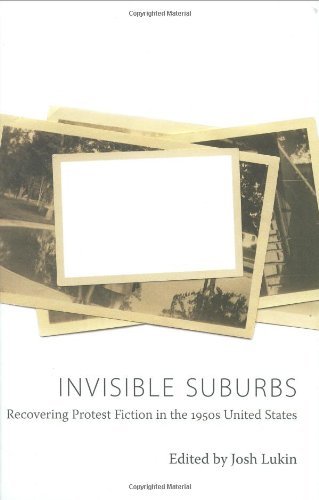
Invisible Suburbs: Recovering Protest Fiction in the 1950s United States
Product details
| Management number | 231914543 | Release Date | 2026/06/18 | List Price | $9.83 | Model Number | 231914543 | ||
|---|---|---|---|---|---|---|---|---|---|
| Category | |||||||||
With essays by Stephanie Brown, Ladislava Khailova, Kathlene McDonald, Ian Peddie, Harry Thomas, and Jennifer Worley Were the 1950s an oppressive or a liberating time? Some scholars argue that the Red Scare, newly institutionalized discrimination against gays, and a public discourse saturated with sexism left wounds in American society. Others trace the origins of sixties liberation movements to the fifties and celebrate America's postwar prosperity, or argue that such new phenomena as rock 'n' roll, teenage consumerism, and Beat poetry gave Americans a new sense of freedom and identity. Invisible Suburbs advances a new synthesis of both views from the perspective of literary scholarship. Essayists ask how overlooked literature in the 1950s addressed or anticipated the struggles of disenfranchised groups to receive rights and recognition. Scholars analyze the many ways in which the decade's culture stigmatized women, minorities, and the poor. They uncover work that illustrates how groups and individuals challenged or resisted that oppression, fiction by authors who sometimes found roots in earlier liberation movements and anticipated later struggles. Included are Ian Peddie's examination of how Nelson Algren, keeping alive his Depression-era outrage over class injustice, was condemned by Cold War critics but voiced attitudes that would be picked up by sixties authors and activists; Kathlene McDonald's essay showing how the feminism of Red Scare victim Martha Dodd took a similar path; Ladislava Khailova's writing on disability; and Jennifer Worley's exploration of lesbian pulp fiction of the decade.With essays by Stephanie Brown, Ladislava Khailova, Kathlene McDonald, Ian Peddie, Harry Thomas, and Jennifer Worley Were the 1950s an oppressive or a liberating time? Some scholars argue that the Red Scare, newly institutionalized discrimination against gays, and a public discourse saturated with sexism left wounds in American society. Others trace the origins of sixties liberation movements to the fifties and celebrate America's postwar prosperity, or argue that such new phenomena as rock 'n' roll, teenage consumerism, and Beat poetry gave Americans a new sense of freedom and identity. Invisible Suburbs advances a new synthesis of both views from the perspective of literary scholarship. Essayists ask how overlooked literature in the 1950s addressed or anticipated the struggles of disenfranchised groups to receive rights and recognition. Scholars analyze the many ways in which the decade's culture stigmatized women, minorities, and the poor. They uncover work that illustrates how groups and individuals challenged or resisted that oppression, fiction by authors who sometimes found roots in earlier liberation movements and anticipated later struggles. Included are Ian Peddie's examination of how Nelson Algren, keeping alive his Depression-era outrage over class injustice, was condemned by Cold War critics but voiced attitudes that would be picked up by sixties authors and activists; Kathlene McDonald's essay showing how the feminism of Red Scare victim Martha Dodd took a similar path; Ladislava Khailova's writing on disability; and Jennifer Worley's exploration of lesbian pulp fiction of the decade. Read more
| ASIN | B001W6PWTA |
|---|---|
| XRay | Not Enabled |
| Language | English |
| File size | 2.4 MB |
| Page Flip | Not Enabled |
| Publisher | University Press of Mississippi |
| Word Wise | Enabled |
| Print length | 240 pages |
| Accessibility | Learn more |
| Publication date | August 1, 2008 |
| Enhanced typesetting | Not Enabled |
Bestseller ranking
1950s




Customers who viewed this product also viewed
Free-Weight Racks


Correction of product information
If you notice any omissions or errors in the product information on this page, please use the correction request form below.
Correction Request Form